
REVIEW · GLASGOW TOURS
Standing Stones, Inveraray and Kilchurn Castles & Highland Tour starting Glasgow
Castles and ancient stones in one long day. This tour strings together Loch Lomond views, clan-era sites, and walking stops in a small 16-seat minibus, so you get real time outside the bus rather than a quick photo run.
I especially like the mix of famous names and early Scotland sites. You’ll also appreciate how guides keep the day moving, with plenty of context tied to what you can actually see, like standing stones you can walk up to and castle ruins with clear links to the Campbell clan.
One consideration: it is a full day with lots of driving, and food and drink are on you. If you want lots of long stops or a heavy lesson every hour, you might find the pacing a bit brisk.
In This Review
- Quick hits before you go
- A Glasgow departure that actually feels organized
- Loch Lomond and the Trossachs: the views that set the tone
- Rest and be Thankful and Glen Crow: quick but scenic
- Inveraray Castle and Gardens: castle grandeur with a clear Campbell thread
- Dunadd Fort and the ancient power behind the scenes
- Kilmartin Glen and the cup-and-ring rock art
- What I think makes this stop work for most people
- Loch Awe to Kilchurn Castle: ruined fortress, dramatic water
- Through Lochgilphead and Tyndrum: keeping the day efficient
- The guides: where the day earns its money
- Small-group comfort in a 16-seat minibus
- What to eat and bring: plan for no included meals
- Weather, timing, and walking: the day is active but not extreme
- Value for money: $90.11 and what you should watch
- Should you book Standing Stones, Inveraray and Kilchurn?
Quick hits before you go
- Small group (max 16) keeps the day friendly and easier to ask questions.
- Active but short walks mean comfy shoes matter, but you do not need marathon stamina.
- Inveraray Castle visit time is included in the schedule, but entry is not included, and winter closures apply.
- Loch Lomond stops like Luss give you classic village-and-water scenery without stress.
- Kilchurn Castle ruins at Loch Awe deliver big views, even though the castle itself is weathered and ruined.
- Nut-free vehicle policy is real, so skip snacks with nuts if you are planning to bring your own.
More of Glasgow and what leaves from it
- From Glasgow: Oban, Glencoe, Highland Lochs & Castles Tour
★ 4.9 · 2,123 reviews - City Sightseeing Glasgow Hop-On Hop-Off Bus Tour
★ 4.5 · 1,873 reviews - From Glasgow: Glenfinnan, Fort William, and Glencoe Day Trip
★ 4.7 · 1,753 reviews
A Glasgow departure that actually feels organized
You start in Glasgow at the Buchanan Bus Station Taxi Rank on Killermont St, with a morning start time of 8:00 AM. From there, the day is built around one simple idea: point the minibus at Scotland’s west-coast highlights, then stop often enough that the scenery turns into memorable moments.
Because the group size stays small, you tend to move as a unit and not get separated into a giant bus swarm. That matters on a day like this, when you want everyone to hear the same explanations and walk at roughly the same pace. It also helps you bond quickly with fellow passengers, which is a theme I saw repeatedly in the feedback.
The logistics are straightforward too. There is no hotel pick-up or drop-off listed, so you’ll want to get yourself to the meeting point on your own. It is also near public transport, which is helpful if you prefer not to rely on taxis.
Loch Lomond and the Trossachs: the views that set the tone
After picking up extra visitors in Balloch, the tour moves into the heart of Loch Lomond and The Trossachs National Park. This is where you get the “Scotland postcard” payoff early: water, wooded slopes, and village stop time that is long enough to actually look around.
Luss is one of the stronger breaks on the day. You get about 40 minutes, which is enough to wander the waterfront and get a feel for a place locals choose for a quiet day out. If the weather is clear, you can also see why this area is a go-to for writers, photographers, and everyone who wants “first view of the day” to be good.
Then you pass through Lochside and Sea Loch villages along the way. Even when you are not walking much at these stops, you’re still getting the rhythm of the region. That matters because it keeps the day from feeling like nonstop castle ticket lines. You see enough variety to reset your eyes between historical sites.
Rest and be Thankful and Glen Crow: quick but scenic
The tour includes a stop to see Glen Crow at the Rest and be Thankful area. It is a short moment, but this is one of those road-history corners where the scenery and the story both feel tied together. If you like big driving viewpoints, you’ll likely enjoy it.
Dress for it too. This is Scotland, and weather can flip fast, especially around open viewpoints. Layers are key, and waterproof gear is worth packing even if you wake up to sun.
Other Highland days and longer tours


Inveraray Castle and Gardens: castle grandeur with a clear Campbell thread
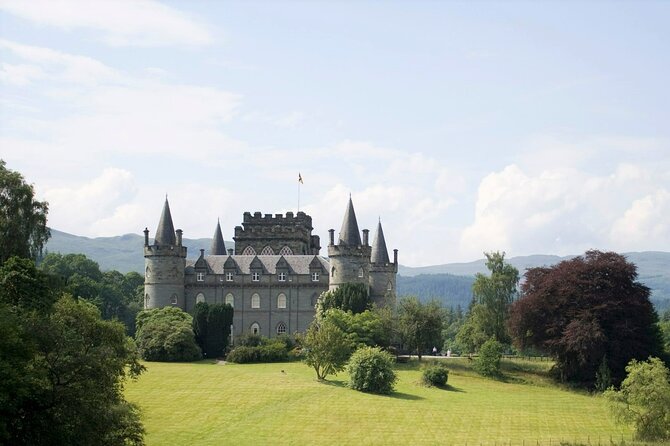
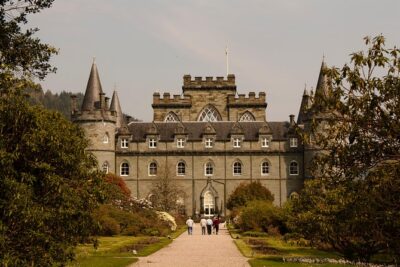
Inveraray Castle is a major reason people book this day. You’ll spend around 1 hour 20 minutes here, and the castle experience connects directly to Scotland’s clan world. Inveraray is Gothic in style and is associated with the Dukes of Argyll, plus the story of the Campbell clan.
If you care about how Scotland’s power shifted over time, this is where the day starts to feel less random. The tour focuses on the Campbell role in the Wars of Scottish Independence, and there is mention of rifles that were supposedly used against Jacobite soldiers. That kind of detail helps you see the castle as more than a pretty building.
For garden lovers, there is also a 16-acre garden option. Whether you can fully explore it will depend on the day’s timing and conditions, but the garden is part of why Inveraray feels like a “stay awhile” stop rather than a quick glance.
Two practical notes you should plan around:
- Entry fees are not included, so you’ll want some cash or a card ready for the castle and gardens.
- Inveraray Castle is closed from November 1 to March 31, so if you are traveling in winter, double-check alternative dates.
Dunadd Fort and the ancient power behind the scenes
Between the more famous sites, the tour includes Dunadd Fort, described as an ancient and royal power center of Celtic kings. You’ll hear that it was first mentioned in AD 683 and associated with the Dál Riata, the group tied to early Scottish history.
This stop is important for balance. If you only see late-medieval castles, Scotland can start to feel like it begins in the Middle Ages. Dunadd adds a longer timeline and helps you connect stones and forts to the same big human question: where power sat, and how people defended it.
You might not spend a long time here compared to the lochs, but it gives the day a backbone. It also makes the later standing-stone stops feel more grounded in the same region and idea of settlement over time.
Kilmartin Glen and the cup-and-ring rock art
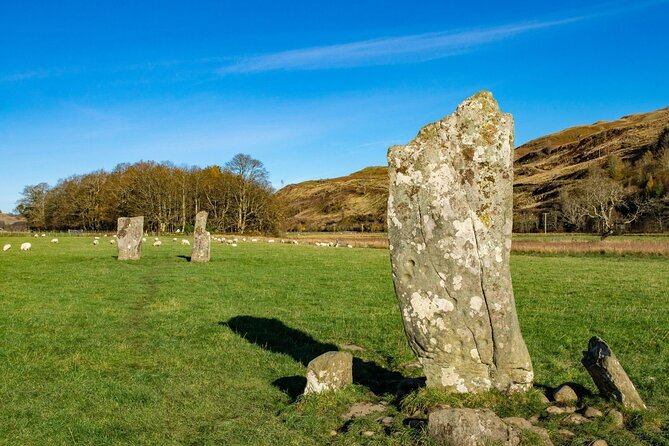
Kilmartin Glen is one of the best “pause and look” sections. You get out for a short walk to see cup and ring marked rock art. The descriptions put the carvings at over 4,000 years old, which gives you an immediate scale shift from castle stories to something far older.
Then the tour adds a fun historical imagination layer, especially if you know the Outlander storyline. You are essentially in the right kind of setting for that feeling of discovering ancient stones, and you’ll see a collection described as standing stones, stone circles, and burial cairns that are believed to be over 5,000 years old.
What I think makes this stop work for most people
You do not need to be an archaeology nerd. You just need curiosity. The rock art is close enough to make you think, “How do people even record this kind of thing?” And the standing stones make the whole area feel like an outdoor museum without rope barriers and museum lighting.
If you prefer less walking, the good news is that this is described as a short walk. Still, comfy shoes matter because you are on real ground outdoors, and Scotland likes to keep it damp.
Loch Awe to Kilchurn Castle: ruined fortress, dramatic water
Loch Awe is one of those long Scottish lakes that keeps delivering new angles as you drive the single-track road. There is a quick stop that lets you take in the water before you reach Kilchurn Castle.
Kilchurn Castle is a ruined stronghold connected to the Campbell clan. Unlike Inveraray, this one is visibly battered by time and nature. It was used as a fortress, then a comfortable residence, and later a garrison stronghold before being destroyed by lightning.
What makes Kilchurn a high-value stop is the setting. Even if you know the castle is ruined, the location on the banks of Loch Awe makes it feel complete. You walk in for a short visit and get that “how did they build here” moment, even just standing outside.
If you like ruins, you’ll probably love it. If you only want perfect restored interiors, you might find it less satisfying, since you’re seeing a fortress in aftermath form. But it is hard to beat the views.
Through Lochgilphead and Tyndrum: keeping the day efficient
The tour passes through Lochgilphead and stops in Tyndrum. These are smaller waypoints, and the purpose is practical: positioning the group so you hit the key sites at the right times while keeping travel smooth.
This is where you’ll feel the trade-off of the day. Driving is part of the experience, and not every minute is spent at a walking site. Still, the stops help break up long stretches so you get occasional chances to stretch, look around, and reset.
If you hate being in a vehicle for extended periods, the overall length might be a challenge. Some people clock the day longer than the advertised estimate, so plan your evening back in Glasgow accordingly.
The guides: where the day earns its money
A big reason this tour scores extremely high is the people running it. I saw a recurring pattern of guides who made the stories clear, fun, and easy to follow. Names that came up include Daniel N., Callum, James, John, Jim, Cal, Matt, Lauren, Cat, and Rachel. That variety matters, because it suggests the quality is not tied to one standout person.
What stands out in the praise is the combination of history plus practical details. Guides call out what you should notice for photos. They share stories that connect the place to bigger Scotland themes. And they keep the day paced so you are not stuck waiting around forever.
One note for expectations: some people said they wanted more deep explanation at the start, while others loved the flow. So if you need a nonstop lecture, you might find you have to ask for specifics.
Small-group comfort in a 16-seat minibus
Transport is in an air-conditioned 16-seater minibus. That is a nice setup for a day like this because you do not feel marooned in a giant coach. It is also easier for the guide to manage timing, especially when you are taking short walks and moving through viewpoints.
If you are tall, the smaller van can be a relief, and some comments specifically noted comfort even for bigger frames. Still, the best advice is to dress and pack for field conditions. Bring a layer for the vehicle too, because air conditioning plus Scottish weather can feel cool.
What to eat and bring: plan for no included meals
No food or drinks are included. That means you need to budget for at least a lunch stop and snacks or a drink during the day. One practical tip is simple: bring cash and maybe a small card backup, since small village stops can vary.
Also, the minibus is a nut-free zone. The tour explicitly requests you not bring products containing nuts. If you have food sensitivities, this is good news, but it means you should check your snacks before you get on.
Weather, timing, and walking: the day is active but not extreme
The tour runs in all weather conditions, so you should dress for rain and cool wind even if the forecast looks friendly. The recommendation is layers, waterproof clothing, and walking shoes or boots.
The walking is described as short guided walks at key sites, like Kilmartin Glen and both Inveraray and Kilchurn areas. That is manageable for most people age 12 and up, but it is still outdoors on uneven ground at times. Do not assume you will be on perfectly flat paths the whole day.
Value for money: $90.11 and what you should watch
At about $90.11 per person, this tour is priced like a full-day “highlight package.” You get the guide, the minibus transport, and the structure to see multiple major sites without handling car rental, parking, or navigation.
The part to budget carefully is entry fees. Inveraray Castle and Gardens admission is specifically marked as not included, and entry to activities is generally not included. So your real total will depend on which sites you pay to enter and what you choose to do.
Also, Inveraray’s seasonal closure is crucial. If your travel dates fall during November to March, you may not get the same castle-and-garden experience. Your best move is to verify the date-specific plan before you pay.
When it works best is when you want variety in one day: lochs and villages, standing stones and forts, and at least two strong castle experiences in different styles (restored and ruined).
Should you book Standing Stones, Inveraray and Kilchurn?
Book it if you want:
- A packed, well-guided day that combines lochs, villages, castles, and ancient sites
- A small group setting where guides like Daniel N., Callum, James, John, and Lauren can keep the storytelling flowing
- Short walks plus big scenery, without requiring a car or heavy planning
Skip it or rethink it if:
- You get cranky about long driving days and prefer fewer stops
- You need long, unhurried time at every site
- You travel in winter without confirming how Inveraray Castle is handled during closure dates
- You are sensitive to cooler, wetter outdoor walking unless you pack proper layers
If your goal is to get your bearings fast for Scotland’s west, and leave with photos plus real context for what you saw, this is a strong value day trip. Just go in knowing it is a full day, plan for your own lunch, and bring shoes you trust.
Stirling, Lomond and the Trossachs
- From Glasgow: Loch Lomond, Trossachs & Stirling Castle Tour★ 4.7 · 1,397 reviews
- Stirling Castle, Loch Lomond and Cruise Day Tour from Glasgow★ 5.0 · 566 reviews
- Glasgow: Loch Lomond, the Trossachs and Stirling Castle★ 4.5 · 343 reviews
- Glasgow (Greenock) Shore Excursion: Stirling, Loch Lomond & The Highlands★ 4.5 · 267 reviews
Further Into the Highlands
- From Glasgow: Oban, Glencoe, Highland Lochs & Castles Tour★ 4.9 · 2,123 reviews
- From Glasgow: Loch Ness, Glencoe and the Highlands Tour★ 4.6 · 1,746 reviews
- Glasgow: Loch Ness, Glencoe and Highlands Tour with Cruise★ 4.8 · 1,742 reviews
- Oban, Glencoe, Highlands Lochs & Castles Small Group Day Tour from Glasgow★ 5.0 · 1,432 reviews
Glasgow and Points West
- From Glasgow: Oban, Glencoe, Highland Lochs & Castles Tour★ 4.9 · 2,123 reviews
- City Sightseeing Glasgow Hop-On Hop-Off Bus Tour★ 4.5 · 1,873 reviews
- From Glasgow: Glenfinnan, Fort William, and Glencoe Day Trip★ 4.7 · 1,753 reviews
- From Glasgow: Loch Ness, Glencoe and the Highlands Tour★ 4.6 · 1,746 reviews
Fresh off the Glasgow review pile


Glasgow Tours, compared.
 ★ 4.9From Glasgow: Oban, Glencoe, Highland Lochs & Castles TourFrom $392,123 reviews
 ★ 4.5City Sightseeing Glasgow Hop-On Hop-Off Bus TourFrom $271,873 reviews
 ★ 4.7From Glasgow: Glenfinnan, Fort William, and Glencoe Day TripFrom $911,753 reviews
 ★ 4.6From Glasgow: Loch Ness, Glencoe and the Highlands TourFrom $651,746 reviews
 ★ 4.8Glasgow: Loch Ness, Glencoe and Highlands Tour with CruiseFrom $651,742 reviews
 ★ 5.0Oban, Glencoe, Highlands Lochs & Castles Small Group Day Tour from GlasgowFrom $501,432 reviews
 ★ 4.7From Glasgow: Loch Lomond, Trossachs & Stirling Castle TourFrom $711,397 reviews
 ★ 5.0Glasgow City Centre Walking Tour with Local GuideFrom $161,326 reviews