
REVIEW · SHAKESPEARE'S STRATFORD & WARWICK CASTLE
The WalkTalkShow.co.uk – Guided Tour of Stratford upon Avon
Shakespeare feels local here. This guided walk is a focused way to connect the dots between Shakespeare’s life and the streets of Stratford-upon-Avon, with a stop-by-stop story that runs from the Middle Ages to the Tudor era and beyond. I love the short route that still packs in major sights, and I also like the upbeat, question-friendly feel that guides bring, like Marcus, Dwayne, and Glinda. The one drawback to consider is simple, you are on your feet for about 90 minutes, so bring comfy shoes and keep an eye on the weather.
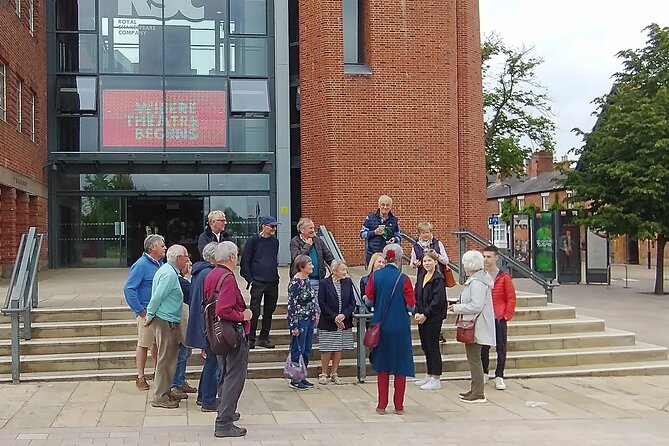
You start and finish at the Royal Shakespeare Theatre, and the group is capped at 24 people, so you should get a more personal pace than big bus tours. Most stops are free to enter, but a couple of key sites have admission not included, so you may want to decide in advance whether you’ll pay extra for those.
In This Review
- Key highlights worth circling
- Where to Start: Royal Shakespeare Theatre, Waterside
- A 1.4 km Walk That Covers 14 Centuries
- Market Cross and Shakespeare’s Family Roots
- Shakespeare’s Birthplace: What Tudor Comfort Actually Looked Like
- The American Fountain Junction and Tudor Pub Survivors
- Bell Court: The Bell, the Markets, and the Drinking Map
- Sheep Street History Corner: John Harvard’s Birthplace in View
- Shakespeare’s New Place: A Big Retirement House Worth Considering
- Guild Chapel and the Schoolroom Theme: Education as a Plot Point
- Chapel Lane and King Edward the Sixth Grammar School Today
- Swan Theatre: Why the Facade Still Matters
- The Final Return to the Royal Shakespeare Theatre
- Price and Value: What $16.47 Really Buys You
- Who Should Book This WalkTalkShow Tour
- Should you book this Stratford walk?
- FAQ
- Where does the tour start?
- How long is the guided tour?
- How far is the walk?
- Are tickets included for the stops?
- What is the maximum group size?
- What happens if the weather is bad?
- Can I cancel and get a full refund?
- Is it near public transportation?
- Are service animals allowed?
Key highlights worth circling
- Royal Shakespeare Theatre as your launch pad, with context for Stratford’s origins right away
- A 1.4 km route in about 90 minutes, built for first-time visitors
- Shakespeare’s Birthplace and the Tudor-era John Shakespeare link at Market Cross
- Bell Court and nearby tavern history, tied to the town’s artisan market culture
- Harvard’s connection on Sheep Street, featuring John Harvard’s birthplace in view
- Guild Chapel and Shakespeare’s schoolroom theme, where education fits the story, not just the sights
Other Stratford visits and castle days
- Cotswolds in a Day Tour from Moreton-in-Marsh / Stratford-on-Avon
★ 5.0 · 1,216 reviews - The Sinister Side of Shakespeare’s Stratford Walking Tour
★ 4.8 · 547 reviews - Stratford-upon-Avon: Shakespeare’s Birthplace Ticket
★ 4.6 · 476 reviews
Where to Start: Royal Shakespeare Theatre, Waterside
The tour meets at the Royal Shakespeare Theatre on Waterside, which is a smart choice. You can grab coffee nearby, spot the theater’s famous frontage, and get oriented before you step into the older parts of town.
This is also where the guide sets the tone. Expect a quick big-picture overview of why Stratford mattered, so when you hit the birthplace and the school, the story has a spine. Many guides lean into light humor here, and it helps you settle into the walk without feeling like you’re stuck in a lecture.
A 1.4 km Walk That Covers 14 Centuries
The whole guided route is about 1.4 km, and the timing runs around 1 hour 30 minutes. That may sound “short,” but the trick is that the stops are packed with specific context, so you’re not just looking at pretty buildings.
One thing I like about this format for you is that it’s efficient. You get a high-quality introduction you can build on later, whether you plan to see a show at the theater, visit museums on your own, or just wander streets with a better sense of what you’re seeing.
The pace is also practical. It’s not a marathon walk, but it is continuous enough that comfortable shoes really matter. If you’re sensitive to uneven pavement or crowds outside the theater, plan for a slower start and a steady rhythm.
Market Cross and Shakespeare’s Family Roots
Right after you set off, you land at the Market Cross area. This is where Stratford shows its trading bones, with one of the original market halls dating back to 1500 AD. The guide ties it to John Shakespeare, William’s father, who was often connected with artisan glove trading.
This is valuable because it gives you a real social map. Shakespeare’s story is usually told like it’s all about genius and drama. This tour nudges it back into daily life: work, markets, and the town’s economy. Once you hear that, other stops start to feel less like separate postcards and more like a single walk through cause and effect.
Also, Market Cross is visually easy to grasp. Even if you’re not a history buff, the market setting helps you understand why Stratford became such a magnet for talent and visitors.





Shakespeare’s Birthplace: What Tudor Comfort Actually Looked Like

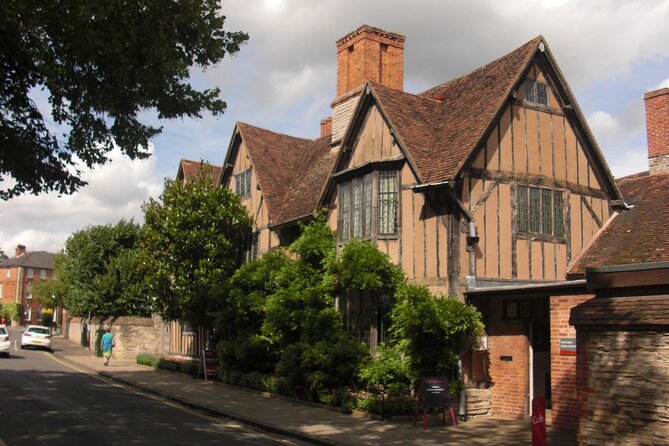
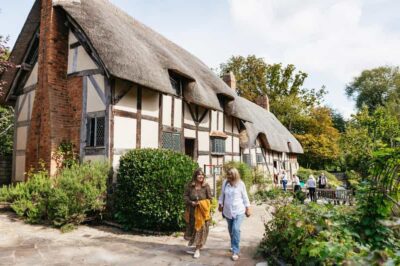
Next up is Shakespeare’s Birthplace. The house dates from the early 1500s, and it’s presented as a living museum. The focus here is the living conditions of a prosperous Tudor family, not just the famous name attached to the door.
This stop tends to be a favorite for people who want the human side. You’re not just learning dates. You’re getting a sense of status, household life, and how a boy growing up in Stratford might have viewed the world around him.
It’s also one of those stops where the guide’s storytelling matters. The house itself is important, but the tour helps you interpret what you’re seeing, so it doesn’t become a quick look and move on.
The American Fountain Junction and Tudor Pub Survivors
The American Fountain stop puts you at a historically important junction. It connects to the livestock market that operated from 1196, tied to when the settlement took shape as a market town. It also points out two pubs that survived from the Tudor period and are still in the area.
This combination is a great example of why this tour works. You get the practical history of commerce, then you connect it to everyday places people would have used. If you’ve ever wondered how towns keep their character, this is it. Some streets are memory machines, and Stratford is one of them.
The drawback here is that this is an outdoor-ish moment in a lively town center. If crowds are heavy, you may need a bit of patience to get the full explanation at the pace the guide wants.
Bell Court: The Bell, the Markets, and the Drinking Map
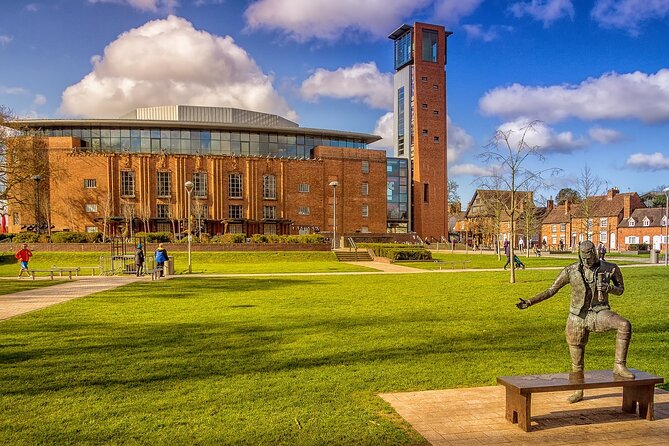
After the junction, you’ll head to Bell Court. The guide points out the bell used to draw people in to the artisan markets, hanging in the main entrance. Bell Court is also a cluster of drinking and dining venues, which makes it an easy place for your brain to switch from “history class” to “I could actually eat here.”
I like this stop because it anchors the culture. Markets were not just economic systems, they were social hubs. The bell is a small detail, but it helps you visualize how people used Stratford day to day.
If you’re planning where to go for lunch or a drink later, this is a good early scouting stop. It gives you places to circle without forcing you to decide immediately.
Sheep Street History Corner: John Harvard’s Birthplace in View
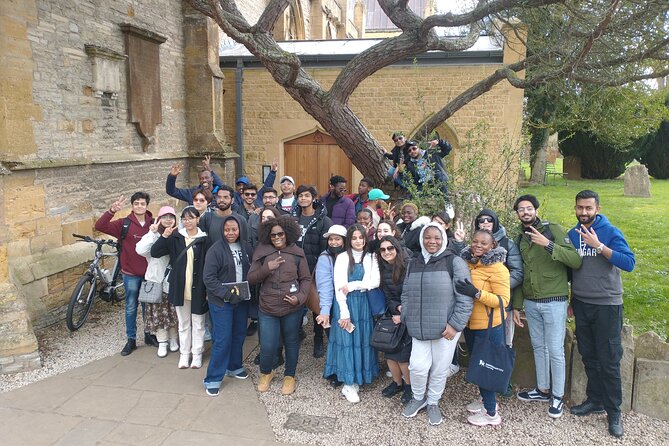
As you reach Sheep Street, the tour calls the area History Corner. From here, you can see buildings spanning five centuries, and that includes John Harvard’s birthplace, tied to the founder of Harvard University.
This is one of the most fun twists on the tour. Stratford is the Shakespeare town, but the connection to America’s oldest-style university story adds a second thread. If you’re traveling with someone who isn’t obsessed with Shakespeare, this Harvard link can keep them engaged.
You’ll also hear about another Tudor era pub, now called The Garrick Inn. It’s the kind of stop that helps you understand Stratford’s continuity. The town didn’t pause after Shakespeare. It kept changing, and the buildings kept adapting.
Shakespeare’s New Place: A Big Retirement House Worth Considering
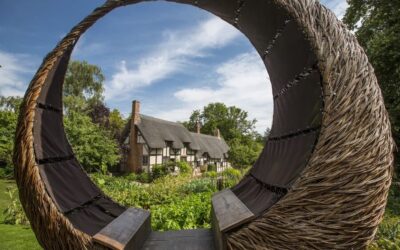
At Shakespeare’s New Place, the tour shifts to William Shakespeare’s later life. The property was originally built in 1483, and Shakespeare bought it in 1597. It’s described as the largest house in town, and the story here mirrors his family’s ups and downs.
One practical note for you: admission for this stop is not included. That means you can either treat it as a look-from-outside moment during the walk, or you can budget extra if you want to go in.
I think this is a good “choose your level” stop. If you love historical interiors and want to see how the house is interpreted, it’s worth adding. If you’d rather spend your time on other activities, you can still get a lot from the story the guide gives outside.
Guild Chapel and the Schoolroom Theme: Education as a Plot Point
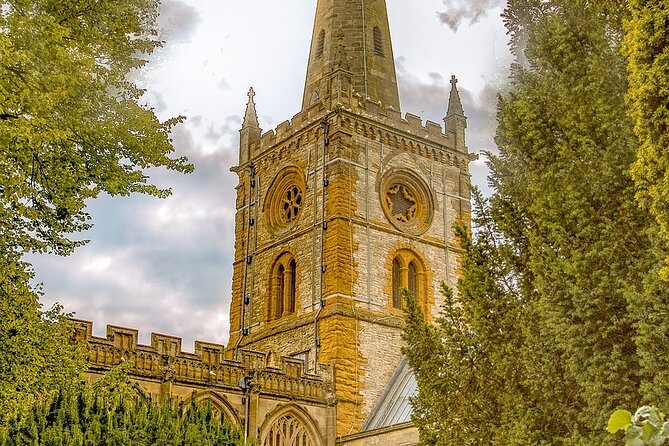
As the tour nears its end, you visit the Guild Chapel, part of the town’s original seat of power with roots dating back to 1269. The Guild Chapel is free to enter, and the guide frames it as a key part of how Stratford ran itself.
Right next door is the Shakespeare’s schoolroom area. This is where the tour turns from buildings to education. The Guild founded the school in 1295, and it is described as existing to this day, with Shakespeare having attended it in the late 1500s.
This is the most “story-driven” portion for many people, because school is not usually the first thing you think of with Shakespeare. But it fits the plot. You start to see how a town’s institutions shape what a person can become.
Admission for the Shakespeare’s Schoolroom & Guildhall stop is not included. So again, you get a decision point. If you’re the type who likes to connect your walk to an interior museum experience, plan for extra time and budget.
Chapel Lane and King Edward the Sixth Grammar School Today
There’s also a brief moment on Chapel Lane where you’ll see King Edward the Sixth Grammar School. The guide explains it as today’s version of the original Guild school that began in 1295, the same school Shakespeare attended.
This is useful because it brings the story into the present without pretending the past is unchanged. You can look at the modern school and connect it to the same educational lineage the guide has been talking about.
It’s a quick stop, so don’t expect a long photo session. But it’s a helpful visual bridge that makes the education theme feel real.
Swan Theatre: Why the Facade Still Matters
Near the end, you reach the Swan Theatre. The guide explains the history of the theatre complex and why the facade of The Swan is all that survives of the original Shakespeare Memorial Theatre.
This is a strong reminder that history often comes to us in fragments. A facade is just a front, but it can still carry the weight of performance memory. If you care about how theater is rebuilt, repurposed, or preserved, this is a meaningful moment.
The stop also gives you another way to frame Stratford’s role in Shakespeare’s world. You’re not only chasing birthplace nostalgia. You’re looking at how Shakespeare’s legacy lives in stage culture and physical spaces.
The Final Return to the Royal Shakespeare Theatre
You end back at the Royal Shakespeare Theatre. The guide wraps up with the chance to ask questions and get suggestions for what to do next in town.
This matters because Stratford can be overwhelming if you arrive with only a list of names. Having a guide point you toward food and drink areas, or suggest which sites are worth a deeper look after the walk, helps you turn the tour into a plan instead of a passing experience.
Also, since the route is compact, people often find it easier to squeeze in another activity after the tour ends, like a museum visit, a theater ticket, or a slow wander by the river.
Price and Value: What $16.47 Really Buys You
At $16.47 per person, this tour is priced in a way that feels fair for what you get. You’re paying for the walking guide plus a structured route through major Stratford stops, and many of those stops include free entry.
That free-entry piece is part of the value equation. You get access to several key sites without needing to buy admission for each one on the spot. Two notable exceptions, Shakespeare’s New Place and Shakespeare’s Schoolroom & Guildhall, are described as admission not included, so you might spend extra if you choose to go inside them.
The value sweet spot is this: you buy one ticket and get a guided framework for the town. Then, if you want, you selectively upgrade to paid entries where your interests are strongest. It’s a smart way to control costs in a place with several ticketed attractions.
Who Should Book This WalkTalkShow Tour
This is a strong pick if you want a first-time introduction that connects Shakespeare to the actual town streets. It’s also ideal if you like walking tours but don’t want to spend half a day. At around 90 minutes on a 1.4 km route, you keep your day flexible.
You’ll probably enjoy it most if:
- You want context, not just photos.
- You like hearing how everyday institutions like markets and schools shaped real people.
- You’re okay walking at a steady pace in town.
If you prefer to go totally at your own speed inside museums, you might find it helpful to treat this as pre-booking homework, then return later to the spots that caught your attention.
Should you book this Stratford walk?
I’d book it if you want a well-paced Shakespeare and Stratford intro that helps you understand what you’re seeing, especially on your first day. For the money, the mix of major landmarks, Tudor-era details, and the extra connections like John Harvard makes it feel efficient rather than rushed.
Just go in with realistic expectations about the walk. Wear shoes you can handle for 90 minutes, and decide ahead of time whether you want to pay admission for Shakespeare’s New Place and the schoolroom, since those are not included.
FAQ
Where does the tour start?
The tour starts at the Royal Shakespeare Theatre, Waterside, Stratford-upon-Avon CV37 6BB, UK.
How long is the guided tour?
It runs for about 1 hour 30 minutes.
How far is the walk?
The guided tour covers about 1.4 km.
Are tickets included for the stops?
Many stops are listed as free, but some admissions are not included, including Shakespeare’s New Place and Shakespeare’s Schoolroom & Guildhall.
What is the maximum group size?
The tour has a maximum of 24 travelers.
What happens if the weather is bad?
This experience requires good weather. If it is canceled due to poor weather, you will be offered a different date or a full refund.
Can I cancel and get a full refund?
Yes, you can cancel for free up to 24 hours in advance for a full refund. If you cancel less than 24 hours before the start time, the amount paid will not be refunded.
Is it near public transportation?
Yes, it is near public transportation.
Are service animals allowed?
Yes, service animals are allowed.
Stratford, Warwick and the Bard
- Cotswolds in a Day Tour from Moreton-in-Marsh / Stratford-on-Avon★ 5.0 · 1,216 reviews
- Shakespeare Distillery Tour – 1pm Ticket★ 5.0 · 598 reviews
- The Sinister Side of Shakespeare’s Stratford Walking Tour★ 4.8 · 547 reviews
- Stratford-upon-Avon: Shakespeare’s Birthplace Ticket★ 4.6 · 476 reviews
Fresh off the Stratford upon Avon review pile




Shakespeare's Stratford & Warwick Castle, compared.
 ★ 4.5Oxford, Stratford-upon-Avon, Cotswolds & Warwick Castle Day TripFrom $1092,943 reviews
 ★ 4.0Warwick Castle Admission TicketFrom $302,096 reviews
 ★ 4.5England in One Day: Stonehenge, Bath, the Cotswolds and Stratford-upon-Avon Day Trip from LondonFrom $1871,344 reviews
 ★ 5.0Cotswolds in a Day Tour from Moreton-in-Marsh / Stratford-on-AvonFrom $1101,216 reviews
 ★ 4.5Warwick Castle, Oxford, Stratford-upon-Avon & Cotswolds Day tripFrom $109828 reviews
 ★ 4.5Oxford, Stratford, Cotswolds & Warwick Castle Tour from LondonFrom $106756 reviews
 ★ 4.4London: Oxford, Stratford, Cotswolds, and Warwick Day TripFrom $103755 reviews
 ★ 5.0Shakespeare Distillery Tour – 1pm TicketFrom $27598 reviews
Also filed under