
REVIEW · CHESTER & CHESHIRE
Fascinating Walking Tours Of Roman Chester With An Authentic Roman Soldier
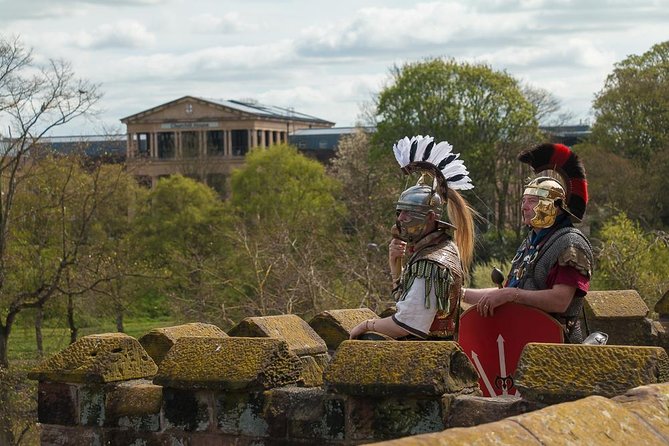
Roman boots, real stones, Chester. This 1.5-hour walking tour turns Chester into a readable Roman landscape, led by a Roman soldier who explains what you are seeing and why it matters. What I like most is the way the guide keeps things human, from daily routines to what the archaeology tells us.
I also like the stops are built around visible evidence, not just talk. You spend time at the Roman Amphitheatre area and at Chester Roman Gardens, where you get a reconstructed hypocaust system you can actually picture in your head.
One consideration: this is a good-weather outing. If rain hits hard, you may be offered a different date or a refund, so pack a layer and expect at least some time outdoors.
In This Review
- Key highlights that matter on the ground
- Roman Chester in 90 minutes with a Roman soldier guide
- Start at Town Hall, finish at the amphitheatre area
- Stop 1 at the Roman Amphitheatre: where fights became stories
- Roman fortress foundations and city walls over 5 meters high
- Chester Roman Gardens: the hypocaust system made visible
- How the soldier-guide approach makes the facts stick
- Value check: what $16.64 buys you in Chester
- Tips on pacing, questions, and getting the most out of each stop
- Should you book? Yes, if you want Roman Chester explained on your feet
- FAQ
- How long is the Roman Chester walking tour?
- How much does the tour cost?
- What language is the tour offered in?
- Where does the tour start?
- Where does the tour end?
- Is the Roman Amphitheatre stop included with admission?
- Does the tour require good weather?
- What is the group size?
- Is there free cancellation?
Key highlights that matter on the ground

- Costumed Roman soldier guides who are happy to answer questions and keep you moving
- Britain’s biggest amphitheatre site as a starting point for the big Roman story
- City walls on Roman fortress foundations, including sections reportedly over 5 meters high
- Chester Roman Gardens hypocaust reconstruction, using pila stones and showing how heating worked
- Hands-on moments, including the chance to handle reproduction items and, in some cases, real artefacts
- Small group size, up to 15 people, which makes Q&A easier and less awkward
More of Chester inside the walls
- Fascinating Walking Tours Of Roman Chester With An Authentic Roman Soldier
★ 5.0 · 1,232 reviews - Chester: Chester Zoo Entry Ticket
★ 4.5 · 967 reviews - Admission Ticket to Sick To Death in Chester
★ 4.5 · 384 reviews
Roman Chester in 90 minutes with a Roman soldier guide
Chester is one of those English cities where the Roman layer is not a museum-only thing. It is in the ground, in the walls, and in the shapes of places you walk past every day. This tour is designed to help you notice that layer fast, without needing a map full of Latin names.
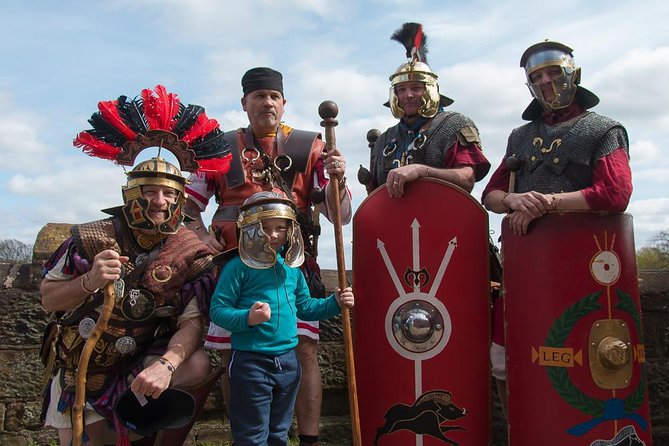
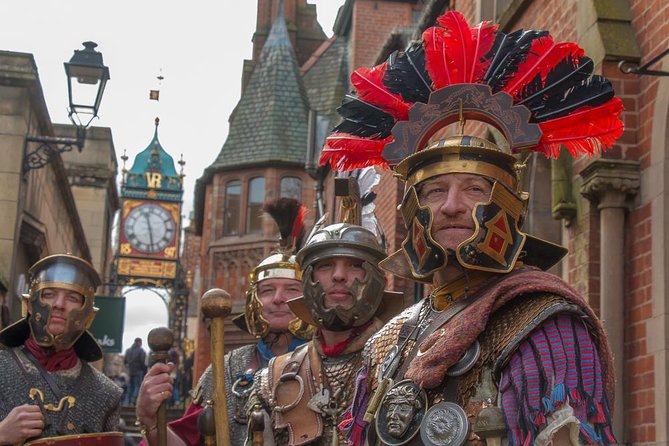
What makes the format work is the costumed soldier guide. When your guide is dressed as a Roman, you stop treating the ruins like scenery and start thinking like a person living there. Guides such as Marcus (often called Optio Marcus), Julius, Faustus, and Tiberius show up in participant notes, and the consistent theme is lots of talk that connects Roman life to what you are standing near.
If you like learning through details you can point at, you are in the right place. The tour is also short enough to fit into a busy day in Chester, yet long enough that you get more than a quick photo stop.
Start at Town Hall, finish at the amphitheatre area
The walk begins at Town Hall, Northgate St, Chester (CH1 2HJ). The end point is listed near 23 Little St John St (CH1 1RF), and the important part is this: the tour terminates at the Roman Amphitheatre, and the guide directs you to your next destination.
That matters for planning. If you have a dinner reservation nearby, aim to book something after the amphitheatre area, not back near the Town Hall. I also suggest you build in a little buffer time, because the pace depends on questions and the group’s interests.
Group size stays small, up to 15 travelers. That is a big deal on tours like this because it keeps the experience from turning into a one-way lecture. You get space to ask odd questions, and most people end up chatting about Roman army life, wages, training, and everyday routines.
You should also expect a walking route through parts of the city where surfaces can be uneven. Bring comfortable shoes, and if the forecast looks sketchy, pack a waterproof layer. The experience specifically requires good weather, and poor weather can trigger a reschedule or refund.
Stop 1 at the Roman Amphitheatre: where fights became stories
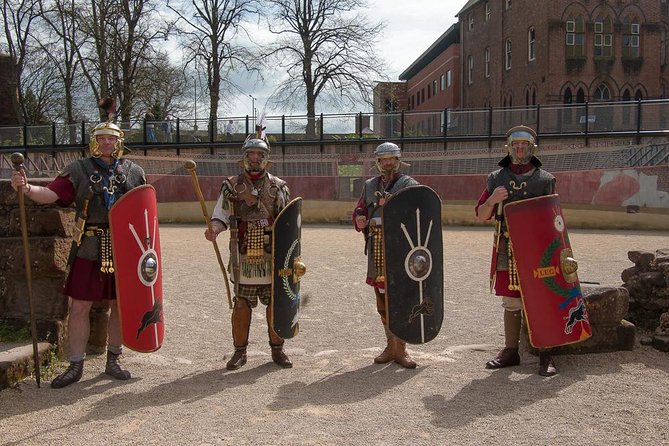
Your first major stop is Chester Roman Amphitheatre. The time here is about 15 minutes, and the big promise is simple: this is the place to understand the lives of people who fought and died there, using archaeological evidence and remains.
Chester’s Roman amphitheatre is often described as Britain’s biggest. Even if you do not remember the exact dimensions, you will feel the scale once you are on the site. The guide’s job is to connect the physical remnants to Roman entertainment and Roman justice, and to frame it in a way that does not just sound dramatic.
What I think you will enjoy most here is the evidence-based approach. You are not just being told what might have happened. You are shown what survives, then guided to what that likely means.
Possible downside: 15 minutes moves quickly. If you are the kind of person who wants to linger and read every sign, you might wish this stop ran longer. Still, the time is well spent because it sets the tone for the rest of the walk.





Roman fortress foundations and city walls over 5 meters high
After the amphitheatre, the tour shifts to the Roman walls and the fortress foundations beneath them. This is one of the best parts of the route if you like seeing how new buildings sit on older structures.
The key detail here is that some sections of original Roman walls still exist, reported as over 5 meters in height. That is not just a fun fact. It changes the way you interpret everything around you. When you can stand near tall surviving masonry, you start to understand Chester as a defended military site, not just a trading outpost.
Your guide will likely explain how the fortress layout influenced later city walls. In other words, you are learning a “layers of place” lesson: what Romans built, what got rebuilt, and how evidence survived through centuries of change.
Watch for where the wall material and construction style shift. Even if you do not call it correctly, you will notice that the wall does not feel uniform everywhere. That is your visual cue that you are standing on different phases of Roman and post-Roman work.
Time is short, and you do not get a long, museum-style breakdown here. But that is also the point. This is a walking tour that helps you see the Roman structure in the city you already know.
Chester Roman Gardens: the hypocaust system made visible
Next up is Chester Roman Gardens, another roughly 15-minute stop. This is where the Roman world turns practical. You get a reconstructed Roman hypocaust heating system, using original pila stones plus reconstructed elements, including a mosaic floor connected to excavations from the Roman military baths.
A hypocaust sounds technical because it is. But the reconstruction is designed to make the concept stick. You should come away understanding the basic idea: heat made its way through spaces under the floor and warmed rooms above. The guide will explain what those pila stones are doing, and why this system mattered for comfort in a bath and military setting.
Why this stop is valuable for you is that it gives a “how it worked” answer, not just a “what it looked like” answer. When Roman heating is shown in a way you can visually track, it becomes easier to imagine daily life. It also helps you appreciate why the Romans invested in maintenance and infrastructure, not just buildings.
One more practical note: the gardens portion can be easier to learn from because it is more interpretive. You are not only looking at remnants. You are seeing reconstructions that explain the purpose of specific parts of the site.
Potential drawback: since it is still a short stop, you may want to take a couple of extra notes or photos. If you are the type who reads everything, plan to spend a bit more time in the gardens after the tour ends, if you have energy.
How the soldier-guide approach makes the facts stick
This tour’s strongest thread is the guide performance, but not in a gimmicky way. The soldier costume works like a learning tool. It invites you into the mindset of the Roman world, then uses that mindset to explain everything from rank and routines to the physical reality of the army.
The names you might hear in participant accounts include Marcus, Julius, Optio Marcus, Faustus, Guyas, Giaus, Gaius, and Hippolyta. Some guides appear to lean funny and question-friendly, with puns and quick answers. Others lean more into the layout and archaeology. The common goal is the same: make you leave with a clearer picture, not a stack of dates.
What makes the tour feel especially “real” is the hands-on element. Some guides bring custom-made legionary kit, and participants note that they could handle reproduction items and, in some cases, real artefacts. If you love tactile learning, that is the kind of thing that makes the Roman world feel less distant.
You also get a chance to ask follow-up questions. That is where the tour can surprise you, even if you already know something about Roman Britain. In participant notes, people with advanced ancient history backgrounds still felt entertained and learned new angles, which tells you the guide is not just repeating memorized facts.
For families, the soldier framing helps. One comment points out that even kids stayed engaged. If you are traveling with mixed ages, this is a strong format because it gives adults content and gives kids a character to focus on.
Value check: what $16.64 buys you in Chester
At $16.64 per person for about 90 minutes, the math works best when you treat this as a guide-led learning experience, not a self-guided ruins hop.
First, the tour’s structure is efficient. You are not spending your time guessing where to stand or which part of a wall matters. A guide routes you through the highlights: the amphitheatre area, the Roman walls and fortress foundations, and Chester Roman Gardens with the hypocaust reconstruction.
Second, the key stops are described as having admission ticket free at those moments. That means you are not stacking extra entry fees on top of your tour price just to see the core places.
Third, you are paying for interpretation. Standing next to ancient masonry or a reconstruction means little if nobody explains the reasoning. Guides focus on archaeology and on how the remains connect to Roman life. That is where the money tends to pay back.
Finally, small group size helps reduce the “you paid for a crowd” problem. With a maximum of 15 travelers, you are more likely to get real answers instead of nods and quick turns.
If you are the kind of traveler who enjoys a guided walk but does not want a full-day commitment, this hits a sweet spot. If you want long time inside buildings or a deep museum session, you might still add one extra self-guided stop afterward.
Tips on pacing, questions, and getting the most out of each stop
A 90-minute tour can feel fast, especially if you are excited by Roman Chester. But you can make it more rewarding with a little planning.
Bring a few questions before you arrive. For example: What did the amphitheatre represent in Roman society? How did the fortress walls shape everyday movement? What would a hypocaust have meant for the comfort of soldiers and visitors? If you ask one or two, the rest of the tour tends to click into place.
Dress for the weather. The experience needs good weather, and Chester can absolutely throw rain at you. If the sky is gray, bring a rain layer that you can move in. Also bring water, since you are outdoors and walking between stops.
If you want photos, do it strategically. Take wide shots when the guide is describing the wider layout, then close-ups when you are looking at specific wall sections or reconstruction elements like the pila stones. The guide’s explanation helps you frame your pictures so you remember what you saw.
One last tip: listen for the little “why this matters” bits. The tour is strongest when it connects physical evidence to human behavior, like how heating systems show priorities or how walls show defense logic.
Should you book? Yes, if you want Roman Chester explained on your feet
I’d book this tour if you want a short, high-impact way to understand Roman Chester. It is especially good for first-timers who do not want to work out where the Roman remains are on their own. The Roman soldier format helps a lot, and the hands-on moments and Q&A energy make it feel interactive rather than passive.
Skip it only if you strongly prefer indoor museum time, or if walking outside in changeable weather would stress you out. The route is time-limited at each stop, so it is not a leisurely, read-every-stone kind of day.
If you are traveling in Chester with limited time and want the city to make sense at the Roman layer, this is a solid pick.
FAQ
How long is the Roman Chester walking tour?
The tour lasts about 1 hour 30 minutes.
How much does the tour cost?
The price is $16.64 per person.
What language is the tour offered in?
The tour is offered in English.
Where does the tour start?
The tour starts at Town Hall, Northgate St, Chester CH1 2HJ, UK.
Where does the tour end?
The tour ends at 23 Little St John St, Chester CH1 1RF, UK, and tours terminate at the Roman Amphitheatre, where the guide directs you to your next destination.
Is the Roman Amphitheatre stop included with admission?
The stop at the Roman Amphitheatre is listed with admission ticket free.
Does the tour require good weather?
Yes. The experience requires good weather, and if it is canceled due to poor weather, you will be offered a different date or a full refund.
What is the group size?
The tour has a maximum of 15 travelers.
Is there free cancellation?
Yes. You can cancel for a full refund up to 24 hours before the experience starts. If you cancel less than 24 hours before, the amount paid will not be refunded.
Chester and Cheshire Days
- Chester: Chester Zoo Entry Ticket★ 4.5 · 967 reviews
- Admission Ticket to Sick To Death in Chester★ 4.5 · 384 reviews
- Chester: City Sightseeing Hop-On Hop-Off Bus Tour★ 4.6 · 274 reviews
- Chester: Half-Hour City Cruise★ 4.6 · 231 reviews
Fresh off the Chester review pile






Chester & Cheshire, compared.
 ★ 4.8From Manchester: North Wales, Snowdonia, and Chester TourFrom $1021,577 reviews
 ★ 4.5Chester: Chester Zoo Entry TicketFrom $33967 reviews
 ★ 4.5Admission Ticket to Sick To Death in ChesterFrom $11384 reviews
 ★ 4.6Chester: City Sightseeing Hop-On Hop-Off Bus TourFrom $13274 reviews
 ★ 4.6Chester: Half-Hour City CruiseFrom $13231 reviews
 ★ 5.0The Hunt for the Cheshire Cat by HiddenCityFrom $40225 reviews
 ★ 5.0Snowdonia & Chester Day Tour from Manchester Including AdmissionFrom $102173 reviews
 ★ 5.0Fun, Flexible Treasure Hunt Around Chester with Cryptic Clues & Hidden GemsFrom $20162 reviews
Also filed under