

REVIEW · CANTERBURY, DOVER & THE KENT COAST
The Canterbury Classic Tour
Canterbury feels like a living puzzle. This 1.5-hour walk gives you the best kind of shortcut through town, from Chaucer’s statue to Roman traces and clock-tower oddities, led by Sam in a small-group setting. I love the tight group size because it keeps questions from getting swallowed. I also love how Sam makes buildings feel personal, not like a lecture. One thing to plan for: a few stops include sights where entry is not included.
I like that you start at the Beaney House of Art & Knowledge, right in the center, and you can use the facilities before you begin. It’s an English-language tour with a mobile ticket, and it runs in a way that feels built for a relaxed evening or a chilly morning. Expect a steady pace rather than a race through postcard stops.
You end at Saint George’s Tower, under the clock tower of the former St George’s Church. The walk is short enough that you still have time to explore on your own afterward, but structured enough that you leave with a clear mental map of Canterbury.
In This Review
- Key highlights you will feel on the street
- Entering Canterbury at the Beaney, with a map in your head
- Chaucer’s statue to Westgate Towers: why Canterbury’s defenses matter
- Marlowe Theatre and Christ Church Gate: fact, spin, and Tudor weirdness
- Roman Museum outside: the WWII rediscovery that reconnected Canterbury to its past
- St Thomas of Canterbury RC Church: Becket, the dove, and why legends persist
- Saint George’s Tower and the clock that keeps old Canterbury visible
- Price and value: what you really pay for at $19.44
- Who should book, and who might skip it
- Should you book the Canterbury Classic Tour?
- FAQ
- How long is the Canterbury Classic Tour?
- How much does the tour cost?
- What group size is this tour limited to?
- Is the tour in English?
- Where does the tour start and end?
- Are admissions included for all stops?
- Are service animals allowed?
- What is the cancellation policy?
- When should I book?
Key highlights you will feel on the street
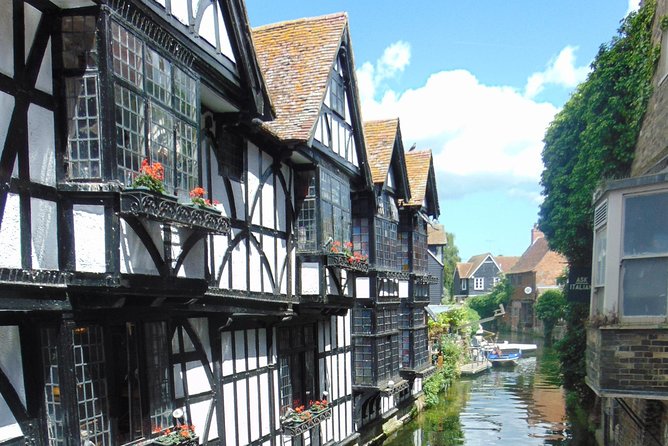
- A maximum group size of 10 means you get real back-and-forth, not just listening from the back
- Guide Sam’s style blends storytelling with architecture, so facts stick without feeling forced
- Quirky city details get explained, like the weirdness built into clocks and symbols
- A mix of eras from medieval walls to Roman traces and Tudor-era landmarks
- Some stops are free, some not included so you can choose whether to pay to go inside
Other Kent days, cathedral to cliffs
- Official Canterbury Guided Walking Tour – 11.00 Tour
★ 5.0 · 422 reviews - Canterbury Cathedral: Entry Ticket with Audio Guide
★ 4.6 · 266 reviews - Official Canterbury Guided Walking Tour – 14.00 Tour
★ 5.0 · 214 reviews
Entering Canterbury at the Beaney, with a map in your head
The tour starts outside the Beaney House of Art & Knowledge on High Street, which is handy because it puts you right where most visitors already end up. Before moving off, you get a chance to settle in, grab a coffee nearby, and handle any last-minute needs so the walk stays comfortable.
This matters more than it sounds. When you walk through Canterbury, you will quickly notice how packed the center is with churches, gateways, lanes, and little architectural surprises. Having a structured route right from the start helps you avoid the common problem of seeing ten things and remembering none.
You also get a clear end goal, Saint George’s Tower. That gives you an easy “done for today” marker, which is useful if you still want to pop into shops or plan dinner afterward. The whole experience is about 90 minutes, so it works well as your first activity in town.
And yes, it’s guided. With a small cap of 10, the conversation stays human. In practice, that means if you are curious about a building feature, you are more likely to get a straight answer instead of waiting for the group to catch up.
Chaucer’s statue to Westgate Towers: why Canterbury’s defenses matter
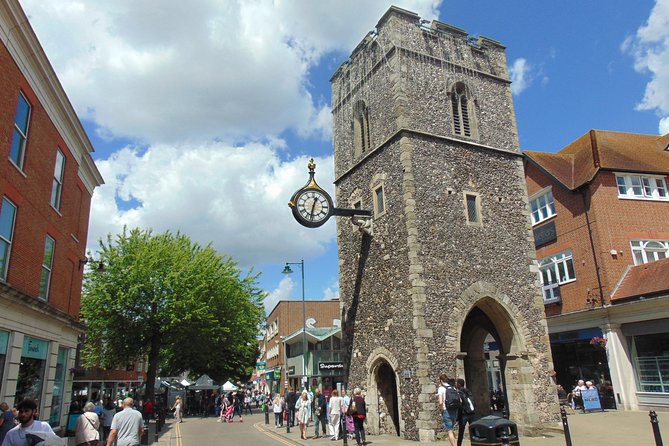
The first stop is Geoffrey Chaucer’s statue, with a focus on the author behind The Canterbury Tales. This is a smart opening because it anchors the whole walk in the reason Canterbury became famous: stories, pilgrims, and the way the city’s identity grew around them.
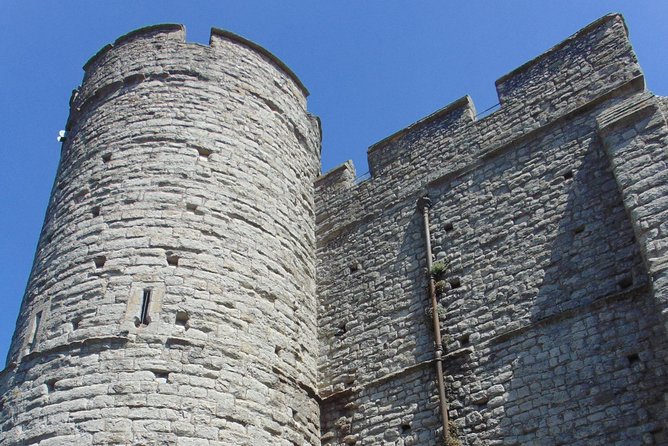
From there, you head toward the Westgate Towers Museum & Viewpoint. This is where the tour starts showing you Canterbury as a place that once had to defend itself. The Westgate Towers are the largest surviving medieval city gate in the UK, and the tour frames it as a “built for conflict” structure, not just a pretty wall.
What you get here is the story behind the shapes. Why the gate was placed where it was, how attacks and defenses could play out, and how the tower functioned as more than a gatehouse. If you want to go further into the viewpoint or museum side, note that admission is not included, so you will decide if you want to pay extra to get inside.
Even if you skip paid entry, the explanation helps you read the building. Once you understand the purpose of a medieval gate, it becomes much easier to spot similar thinking in other European cities.
Marlowe Theatre and Christ Church Gate: fact, spin, and Tudor weirdness
Passing the Marlowe Theatre is a good tonal shift, because you go from medieval walls to a modern structure tied to an old kind of fame. The guide uses Christopher Marlowe as the thread, mixing his reputation as a playwright with the city’s link to intrigue and espionage tales.
This is one of the ways the tour stays entertaining without losing control. Instead of forcing a single “straight facts only” approach, it uses named people to connect eras. That makes the stories easier to follow, and it keeps the walk from feeling like a checklist.
Next comes Christ Church Gate, which is completed to commemorate a Tudor prince and his Spanish bride. Here, the tour nudges you toward a common misconception and then corrects it with the right historical framing. The guide also explains how the gate changed over time, which is a key theme in Canterbury.
Think of it like this: many landmarks look fixed, but they were frequently altered as politics, fashion, and city needs shifted. Once you hear that perspective, you start noticing renovations and “what changed” clues everywhere.
Admission is not included for this stop, so if your goal is just to see the exterior and learn the story behind it, you are fine. If you want to go inside, you will need to plan for extra costs that are not covered.



Roman Museum outside: the WWII rediscovery that reconnected Canterbury to its past
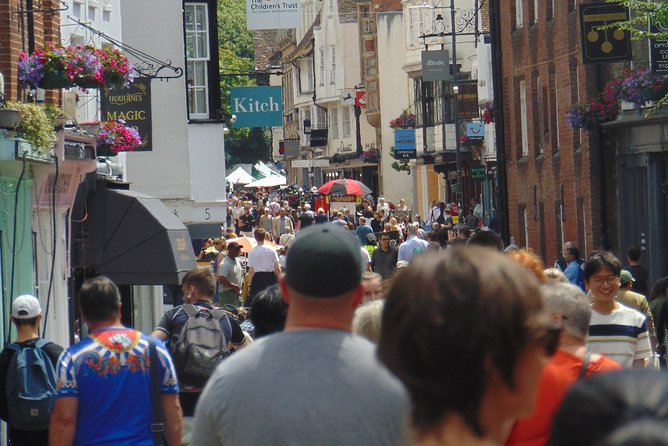
The tour then circles into Roman territory, using the Canterbury Roman Museum area as your reference point. You learn about the Roman city and how it was rediscovered through work tied to the Second World War. That timing is surprising, and it gives the Roman layer a more grounded feel than the usual “ancient mystery” vibe.
This is where Canterbury becomes more than medieval nostalgia. A city that existed in Roman times means the later streets, lanes, and building sites were never started from zero. They grew on top of earlier choices, even if you cannot immediately see it.
While you are in the Butchery Lane area, the guide points out smaller landmarks and symbols that can be easy to miss on your own. The Bell Harry Tower of the Cathedral comes up, along with the city coat of arms and even a bull’s head to discuss. These are the kinds of details that make your photos more interesting, because they look like quirks until you learn what they represent.
The Roman Museum portion is not included, and that is worth flagging. If you are the type who likes hands-on exhibits and artifacts, you might want to budget for admission separately. If you prefer to learn through the walk and then read more later, you can still get a lot from the outdoor context.
By the time you reach the next church stop, the message is clear: Canterbury is stacked. Not in a vague way. In specific, traceable layers that shaped what you see today.
St Thomas of Canterbury RC Church: Becket, the dove, and why legends persist
The group then visits St Thomas of Canterbury RC Church for stories centered on Thomas Becket. This part is powerful because it corrects a basic assumption: he was not from Canterbury, yet he became one of the city’s most important figures.
The guide keeps it moving without turning it into a timeline slog. Instead, you get the emotional logic of the legend, why Becket mattered to people, and how stories like these build reputations that outlast the individuals.
Then there is the dove story connected to Pope Gregory the Great, with a detail that feels almost too strange to be real. That’s the kind of weird-but-memorable moment that makes a walking tour worth it, because you leave with something you can tell people later.
This stop is marked as free for the tour experience, so it is a good place to spend your attention without worrying about extra entry costs. Even if you are not a religious history fanatic, the Becket connection is central to understanding Canterbury’s identity.
Also, because it is a church setting, you tend to experience a change in pace. The noise of the shopping streets fades just a bit, and the building itself helps the stories land.
Saint George’s Tower and the clock that keeps old Canterbury visible
The walk ends underneath Saint George’s Tower, a clock tower tied to the former St George’s Church. This is one of the tour’s clever finishes because it takes you into the present-day shopping area and then shows you how the past stays visible inside daily life.
The guide explains how this “reminder of the past” became part of modern Canterbury. That theme is the quiet payoff of the entire walk. You start with a big literary name, go through defenses and gates, then move through Roman rediscovery and Becket legend, and finally you land in an everyday commercial street with history still built into the view.
Free admission is noted for this final stop, which means you get a strong closing moment without extra ticket decisions. If you have been thinking about whether Canterbury is only about the Cathedral, this ending helps correct that impression. It shows how the city’s meaning spreads beyond the most famous landmark.
When your tour finishes here, you are also well placed for self-guided wandering. You can linger nearby, follow lane signs toward the Cathedral area, or pivot into dinner and shopping without needing to backtrack across town.
Price and value: what you really pay for at $19.44
At $19.44 per person for about 90 minutes, this is positioned as a low-stress introduction to Canterbury. A quick way to think about value is time plus attention: you are not just buying a route, you are buying a guide’s interpretation of why each site matters.
The small cap of 10 is a big part of what makes the price feel fair. In a larger group, city landmarks become background. In a group like this, you can ask about specifics and get answers that help you connect dots.
You also get a mix of free stops and stops where admission is not included. That affects value in a practical way. If you stay outside for the paid portions, you still get the story. If you decide you want the viewpoint or museum experience inside, you should expect some additional spending.
Since the tour is in English and uses a mobile ticket, it stays easy to manage. You do not need to hunt for paper documents or translate your way through meeting points. Just show up, meet your guide, and start walking.
Finally, the timing usually feels right for new visitors. The tour is long enough to build context, but short enough that it does not crowd out your own exploration.
Who should book, and who might skip it
This is an excellent fit if you are visiting Canterbury for the first time and want a fast, friendly way to understand what you are looking at. It is also a good choice if you like stories with named characters, because the walk uses people like Chaucer and Marlowe to connect eras.
Families can enjoy this too, especially if your kids like odd details and quick explanations rather than long museum-style sessions. The pace is designed to keep you moving and to keep each stop focused on a few memorable ideas.
If you already know Canterbury deeply and you want a cathedral-only deep dive, you might find this tour too broad. Likewise, if you dislike walking on city streets for an hour and a half, pick a more indoor option instead.
And if you are traveling on a tight budget, plan around the fact that some sights along the route have admission fees not included. You can still enjoy the walk without paying for every interior space, but it helps to be mentally ready.
Should you book the Canterbury Classic Tour?
Book it if you want a smart orientation to Canterbury, with a guide like Sam who turns common landmarks into clear, human stories. It is one of those experiences that helps your photos look better later, because you know what you are photographing.
Skip it or pair it carefully if you are mostly interested in one single site, like the Cathedral only. In that case, spend your time deeper there and let someone else cover the gates, Roman rediscovery angle, and Tudor quirks.
If you do book, I suggest you bring comfortable shoes and dress for the weather. Canterbury mornings can get cold, and you will feel every minute of it if you show up underdressed.
Finally, book early if you can. The typical booking window is about 33 days in advance, and small group tours like this tend to fill when people plan their evenings.
FAQ
How long is the Canterbury Classic Tour?
It lasts about 1 hour 30 minutes.
How much does the tour cost?
The price is $19.44 per person.
What group size is this tour limited to?
The tour has a maximum of 10 travelers.
Is the tour in English?
Yes, it is offered in English.
Where does the tour start and end?
It starts outside The Beaney House of Art and Knowledge, 18 High St, Canterbury CT1 2RA, UK. It ends beneath Saint George’s Tower, 27 St George’s St, Canterbury CT1 2LE, UK.
Are admissions included for all stops?
Not all stops include admission. Some stops are free, while others list admission as not included.
Are service animals allowed?
Yes, service animals are allowed.
What is the cancellation policy?
Free cancellation is available up to 24 hours in advance for a full refund. Canceling less than 24 hours before the start time is not refunded.
When should I book?
On average, this tour is booked about 33 days in advance.
Kent: Cathedral, Castle, Cliffs
- Canterbury: Walking Tour with Green Badge Guide★ 4.8 · 709 reviews
- Official Canterbury Guided Walking Tour – 11.00 Tour★ 5.0 · 422 reviews
- Canterbury Cathedral: Entry Ticket with Audio Guide★ 4.6 · 266 reviews
- Official Canterbury Guided Walking Tour – 14.00 Tour★ 5.0 · 214 reviews
Fresh off the Canterbury review pile


Canterbury, Dover & the Kent Coast, compared.
 ★ 4.5Leeds Castle, Cliffs of Dover and Canterbury Day Trip from London with Guided Cathedral TourFrom $1452,820 reviews
 ★ 4.6From London: White Cliffs of Dover and Canterbury Day TripFrom $1062,623 reviews
 ★ 4.9London: South Downs White Cliffs Day Trip with Train TicketsFrom $1201,441 reviews
 ★ 4.6London: Canterbury Cathedral, Dover Castle, and White CliffsFrom $148973 reviews
 ★ 4.5Canterbury Cathedral, Dover Castle & White Cliffs Guided Day Tour from LondonFrom $152837 reviews
 ★ 4.4From London: Leeds Castle, Canterbury Cathedral & DoverFrom $141735 reviews
 ★ 4.7Dover Castle Admission TicketFrom $33735 reviews
 ★ 4.8Canterbury: Walking Tour with Green Badge GuideFrom $20709 reviews
Also filed under